
Sample chapter · Contemporary Issues · Section A (30 Marks)
Social Disputes and Conflict
You are reading the opening of this topic, exactly as it appears inside HaakimSaab. Chapter 1: Social Issues.
Introduction
Every society has disagreements. Some are small like two neighbors arguing over a boundary wall. Some are big, like a whole community fighting for their right to be included in decision-making.
These different types of clashes differ in size, their depth, and in how they end. Social science has separated them into two ideas: Social Dispute (सामाजिक विवाद). and Social Conflict (सामाजिक द्वन्द्व).
In simple terms, a dispute is a clash over a specific claim that can be settled by agreement or by a decision.
A conflict is a deeper clash between groups over power, values and identity, which is difficult to be settled by one argument alone.
Nepal has seen both.
It went through a ten year armed conflict (1996 to 2006), then movements for inclusion and federalism, and more recently communal tension and the Gen Z protests of 2025.
In Nepal, everyday disputes over land, water, wages and family matters now go first to the judicial committees (न्यायिक समिति) of Nepal's 753 local governments.
Social Dispute
A social dispute is a disagreement between two or more parties over a specific issue, where one side makes a claim and the other side refuses it.
For instance, a farmer says his neighbour's goat ate his maize crop and asks for payment. The neighbour says it was not his goat. Here, there is one clear issue, the damaged crop, and two sides: one makes the claim and other denies it. This is a dispute.
Disputes are usually about interests: land, money, water, wages, property, rent, a boundary or a service. And these interests can be bargained and settled. Therefore, a dispute can normally be settled by talking, mediation, or a decision by a judicial committee or a court.
John Burton, stated that "Disputes were those confrontations that could be settled by traditional means of negotiation or arbitration, while conflicts had to be resolved by analytical processes."
Features of Social Disputes
There are five major features of disputes:
A specific issue: The disagreement is about one clear matter, such as a boundary, a payment or a share.
Identifiable parties: It is clear who is on each side, usually individuals, households or small groups.
A claim and a counterclaim: One side asserts a right; the other side denies it.
Negotiable interests: The matter can be divided, paid for or compromised.
Settled by agreement or decision: It ends when the parties agree, or when a mediator, a judicial committee or a court decides.
Social Disputes in Nepal
In Nepal, most everyday disputes go first to the judicial committee of the local government.
A judicial committee is a three member body in every rural municipality and municipality, set up under Article 217 of the Constitution.The Deputy Mayor leads it in a municipality and the Vice Chairperson in a rural municipality. Its job is to settle local disputes quickly and cheaply, close to where people live.
Section 47 of the Local Government Operation Act 2074 lists the disputes it handles.
They fall into two groups:
Disputes the committee can decide (section 47(1))
Boundaries of fields, dams, irrigation canals, and the sharing and use of water
Damage to another person's crops
Unpaid wages (ज्याला मजदुरी)
Not caring for senior citizens
Not giving food, clothing or education to minor children or a spouse
House rent claims of up to Rs 25 lakh a year
Blocking a public path, cattle trail, grazing ground, canal or cremation site that has been in use since old times
Disputes it can settle only through mediation (मेलमिलाप) (section 47(2))
Divorce (सम्बन्ध विच्छेद)
Assault that can carry up to one year in prison, where no body part is cut off or disabled
Defamation (गाली बेइज्जती)
Noise or thrown waste that disturbs neighbours
If mediation fails, the case goes to court. However, under section 47(3), the parties can also go straight to court for these disputes.
In Nepal, family disputes have risen sharply. Divorce is now the most common type of case in Nepal's courts. In FY 2081/82, 42 thousand divorce cases were filed, against around 14 thusand in FY 2076/77.
Social Conflict
A social conflict is a struggle between groups whose goals, values or interests are incompatible. Here, incompatible means that both cannot be satisfied at the same time.
For instance, a rural municipality has money for only one health post. Ward 3 wants it built in Ward 3, and Ward 5 wants it built in Ward 5. If one ward gets it, the other cannot, and both cannot happen at the same time.
A conflict goes deeper than a dispute. It is often about who has power, whose values count, and whose identity is respected.
Peter Wallensteen (Understanding Conflict Resolution): a conflict is "a social situation in which a minimum of two actors (parties) strive to acquire an available set of scarce resources at the same moment in time ."
Peace studies describe a conflict as a triangle with three corners: contradiction, attitude, and behavior. These are considered to be the three parts of every conflict:
Contradiction (अन्तर्विरोध): The real problem between the two sides. For instance, Ward 3 and Ward 5 both want the only health post.
Attitude (दृष्टिकोण): What each side thinks and feels about the other (fear, suspicion, prejudice, anger). For instance, people in Ward 3 start to believe that Ward 5 is always favoured.
Behaviour (व्यवहार): What each side actually does such as protests, strikes, threats. For instance, people in Ward 3 lock the municipality office in protest.
Therefore, a conflict can exist even when nobody is fighting. The contradiction and the attitudes may be there for years before any behaviour appears. This hidden stage is called latent conflict (सुषुप्त द्वन्द्व).
Conflict is however not the same as violence. Violence is only one form that conflict can take. Most conflicts in Nepal are carried out through petitions, protests, elections, courts and negotiation, not weapons.
Difference between Social Dispute and Social Conflict
While the two words are used interchangeably, they do not mean the same thing.
The clearest line between them was drawn by John Burton, a peace scholar. He said,
"Disputes involve negotiable interests. While conflicts are concerned with issues that are not neogiable and issues that relate to ontological human needs that cannot be compromised."
Here, ontological human needs means the needs that come with being human, such as identity, security, recognition, and dignity. And this is the reason conflict cannot be bargained.
For instance, two brothers dividing their father's property have a dispute. They can come to a negotiated middle ground. However, when a Dalit is stopped from entering a temple, the issue is dignity, and no payment can settle it. This is a conflict.
Some of the major differences are provided below:
Basis | Social Dispute | Social Conflict |
|---|---|---|
Meaning | A disagreement over one specific claim. | A deeper struggle between groups over power, values or identity. |
What is it about? | Interests such as land, money, water, wages or rent. | Needs such as identity, dignity, recognition and security. |
Bargained? | It can be bargained as it can be divided, paid for or compromised. | Usually cannot be bargained. People do not trade their identity or dignity. |
Who is involved? | Individuals, families and small groups. | Communities, castes, ethnic groups, classes, or a group against the state. |
Size | Small and local. | Large. It can spread across a region or the whole country. |
Cause | A specific event or claim, such as unpaid wages. | Deep causes in society, such as inequality, discrimination or exclusion. |
Duration | Short. It ends once a settlement is reached. | Long. It can last for years or even generations. |
Visibility | Always open, because a claim has been made. | It can stay hidden (latent) for years before it comes out. |
Chance of violence | Low | Higher, especially if the conflict is ignored. |
How it ends | Negotiation, mediation, or a decision under the law. | Dialogue, a political agreement, and changes in laws and structures. |
Legal basis in Nepal | Local Government Operation Act 2074 (section 47), Mediation Act 2068, the courts. | The Constitution, the Comprehensive Peace Accord, commissions such as the NHRC and the TRC. |
Interrelation | A dispute left unsettled can grow into a conflict. | A single conflict can give rise to many disputes. |
The Dictionary of Conflict Resolution (Yarn, 1999) states, "a single conflict can give rise to many disputes."
For instance, suppose there is a caste tension in a village, which is a social conflict. That one conflict can show up as many separate disputes.
A Dalit family is stopped from using the common water tap. A worker from the same family is not paid full wages.
The underlying issue of these disputes is caste discrimination, a major conflict.
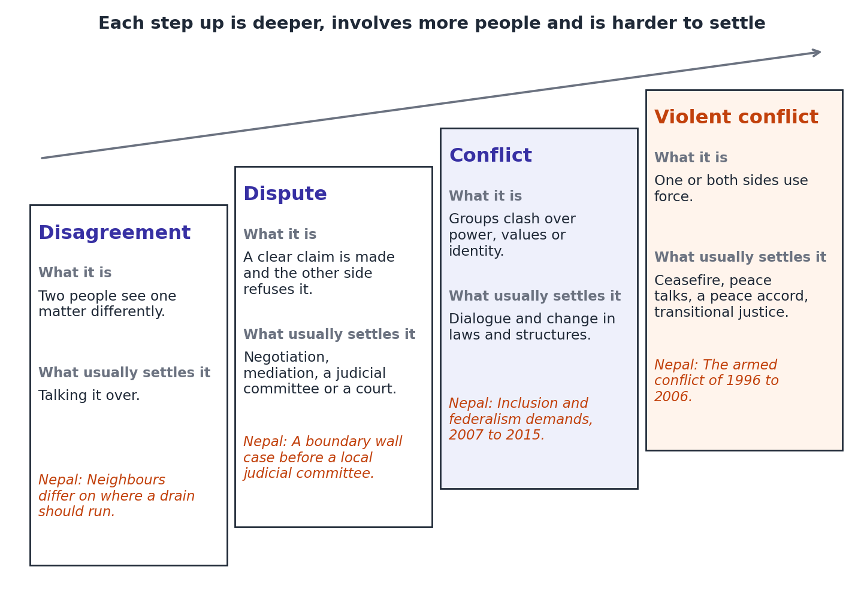
Disagreement to Violent Conflict
HaakimSaab
These notes are for personal study on HaakimSaab and can't be printed.
The topic continues
11 more sections in the full chapter
- 1.1.5 Nature and Characteristics of Social Conflict
- 1.1.6 Scope of Social Conflict
- 1.1.7 Types of Social Conflict
- 1.1.8 Views and Theories of Social Conflict
- 1.1.9 Stages of Conflict
- 1.1.10 Sources and Causes of Social Disputes and Conflict in Nepal
- 1.1.11 Effects of Social Disputes and Conflict
- 1.1.12 Conflict Management (द्वन्द्व व्यवस्थापन)
- 1.1.13 Methods of Resolving Disputes and Conflict
- 1.1.14 Legal and Institutional Provisions in Nepal
- 1.1.15 Challenges in Managing Social Disputes and Conflict in Nepal