
Sample chapter · Foreign Policy · Section B (30 Marks)
Nepal's Role in Least Developed Countries (LDC), Land-Locked Developing Countries (LLDC) and the Group of 77 and China (Developing Countries)
You are reading the opening of this topic, exactly as it appears inside HaakimSaab. Chapter 4: Nepal, Non-Aligned Movement (NAM), and Least Developed Countries.
Introduction to LDCs
Every country in the world is called either developed or developing. Inside the developing group, some countries are much poorer and weaker than the rest.
In 1971 the United Nations decided to give these countries a separate name, least developed countries (LDCs), and to keep an official list of them. This was done so that the poorest could receive special help that the stronger developing countries did not need.
In terms of the UN DESA (United Nations Department of Economic and Social Affairs),
Least developed countries are "low income countries confronting severe structural impediments to sustainable development", which are "highly vulnerable to economic and environmental shocks and have low levels of human assets".
Therefore, three things make an LDC:
it has low income,
its people have weak human assets (poor health and weak schooling), and
its economy is vulnerable to shocks.
LDCs are also called the weakest and the poorest segment of the international community.
One important thing to note here is that a country is put on the list only if it agrees.
However, once it is in, it is taken off the list (called graduation) only when it has fulfilled some specific criteria.
LDC is specifically a legal category because what puts a country in the LDC category is a UN General Assembly Resolution, and another resolution can take it out. Furthermore, it is not the same as a low income country. The World Bank sorts countries by income alone into low, lower middle, upper middle and high income. But as discussed above, the UN's LDC list uses income plus two other tests.
For instance, Nepal falls under World Bank's lower middle income group, but is still an LDC.
Furthermore, all LDCs are developing countries, but most developing countries are not LDCs. For instance, India, Brazil, Malaysia are developing but not LDCs. The LDCs are the poorest 44 of them.
The "Handicap" Categories in the UN
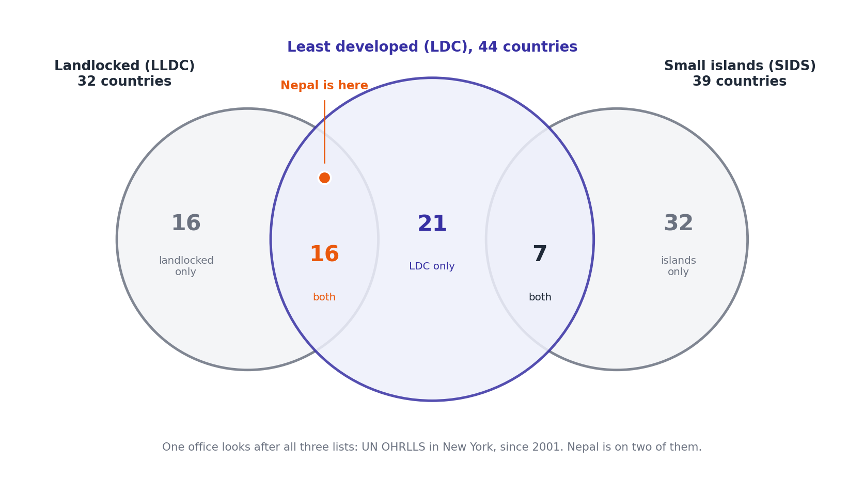
The UN keeps three lists of countries that face a special handicap.
All of these are looked after by the UN Office of the High Representative for the Least Developed Countries, Landlocked Developing Countries and Small Island Developing States (UN OHRLLS), created in 2001.
Group | Number of Countries | Criteria | Nepal |
|---|---|---|---|
Least Developed Countries (LDCs) | 44 |
| Yes, since 1971 |
Landlocked Developing Countries (LLDCs) | 32 |
| Yes |
Small Island Developing States (SIDS) | 39 |
| No |
16 of the 44 LDCs are also landlocked, and 7 of the LDCs are also small islands.
History of the LDC Category
In the 1950s and 1960s many countries in Asia and Africa became independent. They were all called developing countries, but some were in a much worse position than others. When the UN began to give trade preferences to developing countries, the poorest argued that the stringer countries would take all the benefits.
The ask was a separate category and it took 7 years to get it.
The Creation of the Category
In 1964 the first UN Conference on Trade and Development (UNCTAD I in Geneva) agreed that "special attention" should be paid to "the less developed among the developing countries". The G77 was also formed in the same conference.
In 1968 (UNCTAD II in New Delhi), a separate category for the poorest countries was formally proposed.
From 1970 to 1971, the UN's export committee (which was later renamed the the Committee for Development Policy (CDP)) setup the threshold or criteria for the LDCs:
low income per person,
a small share of manufacturing in the economy, and
low adult literacy.
Based on these criteria, a list was made of 25 countries (Nepal was included).
In 18 November 1971, the General Assembly Resolution 2768 (XXVI) approved this first list of 25 countries.
Afghanistan, Bhutan and the Maldives were also on it, along with Sikkim, which became part of India in 1975.
Over the years, countries were added as more of them joined the UN.
Bangladesh in 1975, Cabo Verde in 1977, Vanuatu in 1985, Myanmar in 1987, Cambodia and Zambia in 1991, Angola in 1994.
In the early 2000s, the list reached about 50 countries. Since then 8 countries have left and only 2 have been added (Timor Leste in 2003 and South Sudan in 2012), so the list is now 44.
The Change of Criteria
Initially, the criteria for LDC was focused just on outputs: income per person, the share of manufacturing, and adults literacy.
The problem with this test was that if a country had expensive exports (like oil), it could pass the income criteria but with no guarantee that the people's lives have been lifted.
This is what happened to Equatorial Guinea.
In 1991, the CDP added an index for physical quality of life (health and schooling), and an index for how diversified the economy was. These later became the Human Assets Index (HAI) and the Economic Vulnerability Index (EVI), and gross national income replaced GDP.
In 2011, the vulnerability index included environment (not just economy). It was renamed the Economic and Environmental Vulnerability Index.
Furthermore, in 2024, the rule for leaving on income alone was tightened from twice the graduation line to three times.
HaakimSaab
These notes are for personal study on HaakimSaab and can't be printed.
The topic continues
13 more sections in the full chapter
- 4.3.4 Current Status of the LDCs
- 4.3.5 Data on LDCs
- 4.3.6 The LDC Conferences
- 4.3.7 The Advantages LDCs Get
- 4.3.8 Problems/Challenges Faced by LDCs
- 4.3.9 LDC Inclusion and Graduation
- 4.3.10 Eight Countries have Graduated Till Now
- 4.3.11 Nepal and LDC Graduation
- 4.3.12 The Negative Impacts of Graduation
- 4.3.13 The Positive Impacts of Graduation
- 4.3.14 Role of Nepal in the LDC Category
- 4.3.15 Nepal's Ask for Deferral from 2026 to 2029
- 4.3.16 Way Forward (Making the Graduation Smooth)