

Introduction
You have thought of preparing for Lok Sewa.
But there is one fear holding you back: your Nepali is not strong enough.
Maybe you studied mostly in English. Maybe your school, college, or work background made you more comfortable reading and writing in English. And when you look at the world of Lok Sewa preparation, it may feel like everyone else writes perfect Nepali except you.
So you quietly ask yourself:
“Is Lok Sewa really for someone like me?”
Here is the good news.
Yes, Lok Sewa is for you too.
In all the papers of Lok Sewa, you can write your answers either in English or Nepali. The Public Service Commission does not reward you simply for writing in Nepali, nor does it punish you simply for writing in English.
What matters is not the language itself, but whether your answer is clear, relevant, structured, and analytical.
In Which Language are the Questions Asked?
Lok Sewa questions are usually provided in both Nepali and English.
This applies not only to the first paper/objective paper, but also to all written papers. The question is first given in Nepali, and the English translation is provided alongside it.
Sometimes, the Nepali wording of a question may feel difficult, formal, or too administrative. In such cases, you can simply read the English version to understand what the question is really asking. This makes comprehension much easier.
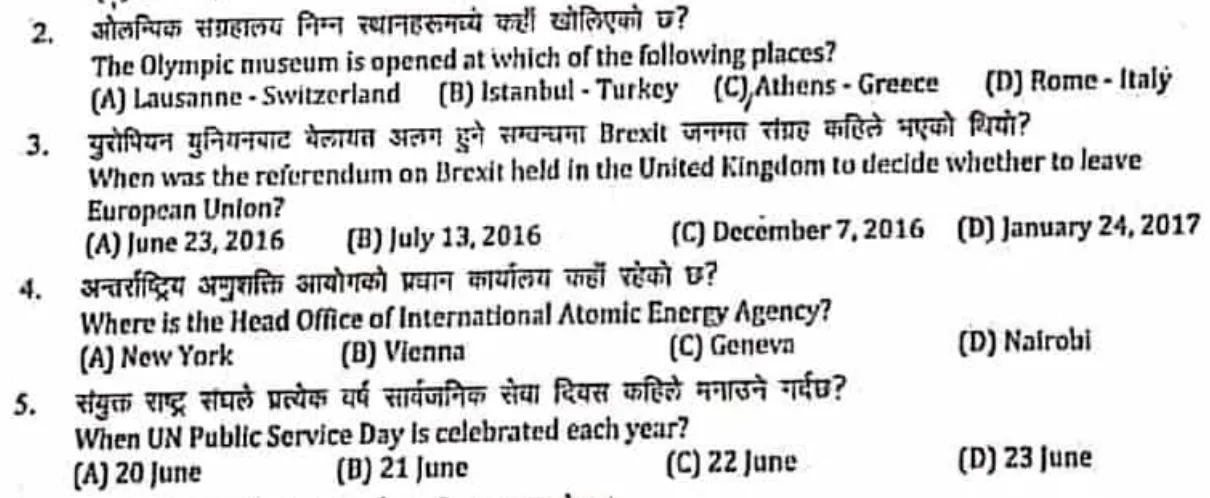
Here is an example of First Paper question asked in Section Officer exam in 2076.
Here is a sample of Section D of Contemporary Issues (Paper III) asked in PSC 2082 for Section Officer.
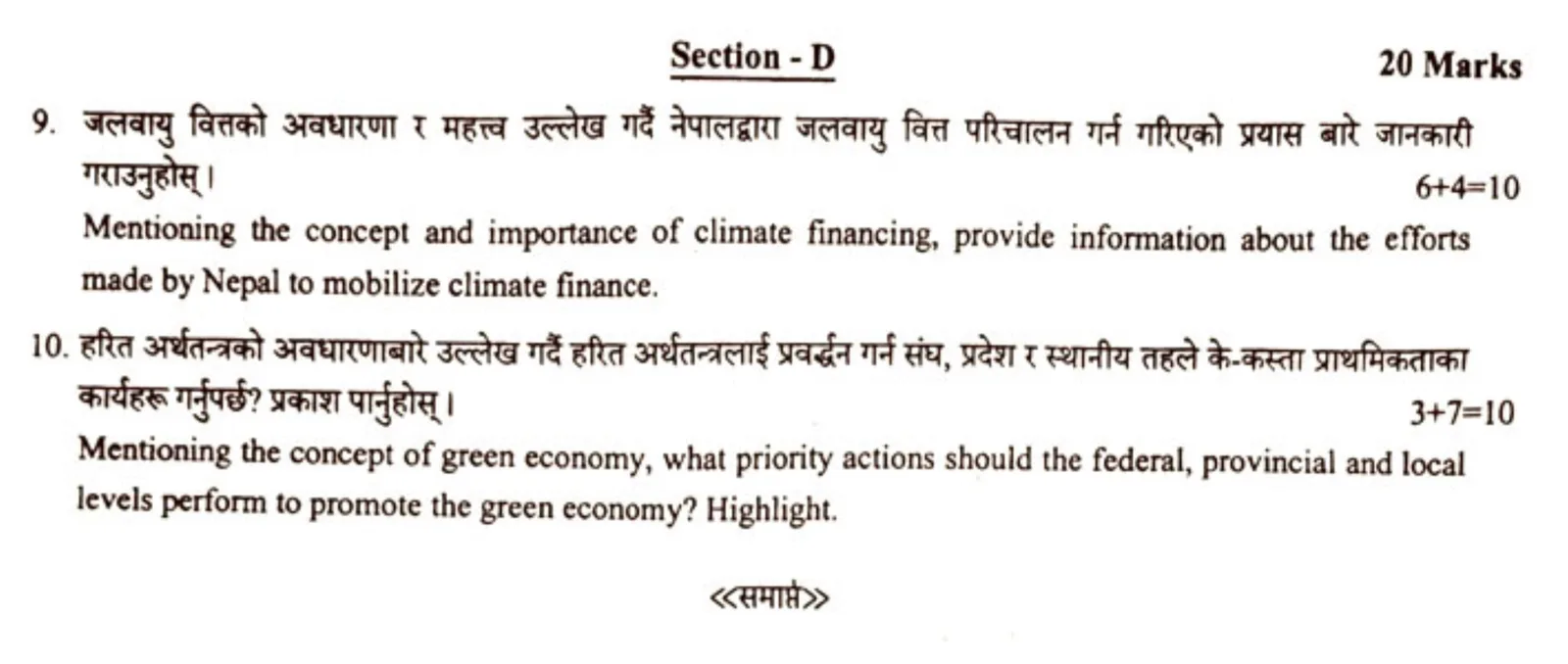
As you can see from the examples above, the questions are asked in both Nepali and English.
However, there is one obvious exception.
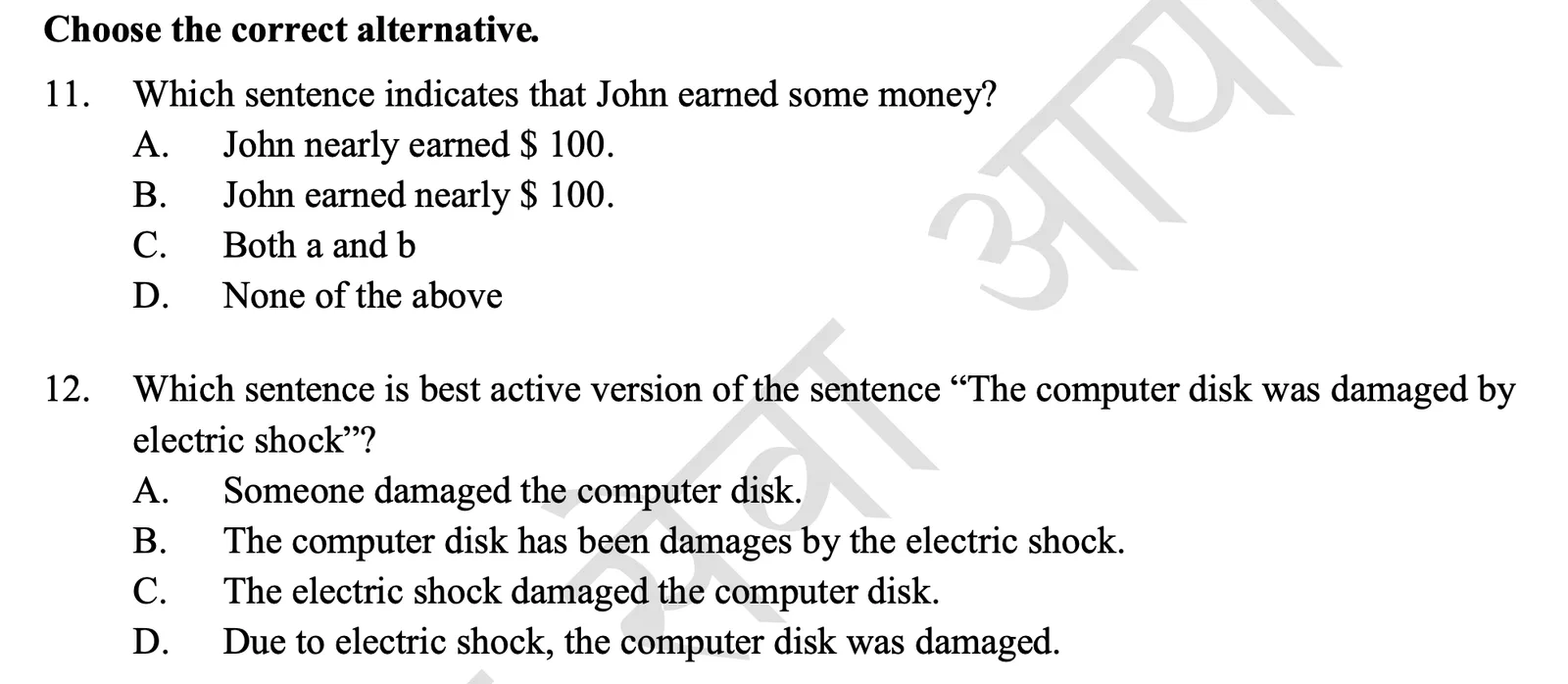
The English language section of the First Paper is, of course, asked only in English. Since that section is designed to test English comprehension, grammar, vocabulary, and language ability, it is not translated into Nepali.
Here's the sample from PSC Sample Questions:
There may also be some cases in the First Paper, especially in General Knowledge, IQ, or fact-based objective questions, where questions appear only in Nepali, only in English, or in a mixed format.
But you do not need to worry too much about this.
Most of these questions are short, direct, and objective in nature. They are not lengthy analytical questions. They usually come with multiple-choice options, which makes them easier to understand even if the wording is not perfectly comfortable for you.
Should I Answer in English or Nepali?
For the First Paper, this question does not matter much because it is objective. You only have to choose the correct option and darken the circle. No long answer. No language problem.
For the written papers, you can generally write in either English or Nepali. This applies to:
Second Paper: Governance Systems
Third Paper: Contemporary Issues
Fourth Paper: Service-Related Paper
Both languages are equally valid. PSC does not give extra marks just because an answer is written in Nepali, and it does not reduce marks just because it is written in English.
You can even use a little bit of both languages where necessary.
For example, if you are writing in English but are confused about the exact translation of a Nepali term, you may use the Nepali term. Similarly, if you are writing in Nepali but a technical English term explains the idea better, you may use that English term.
Also, sometimes, a Nepali phrase may capture a governance problem better than its English translation. Similarly, a short English phrase may make your argument sharper in an otherwise Nepali answer. Used properly, such expressions can actually create a good impression because they show confidence, originality, and command over expression.
In Nepal’s public service delivery, the problem is not always lack of institutions, but lack of coordination among them. As the Nepali saying goes, “भान्से धेरै भए भात बिग्रिन्छ.” When too many agencies act without clear roles, accountability becomes blurred and service delivery suffers.
Just make sure the phrase supports your argument. It should not feel forced.
What About MoFA Papers?
If you are preparing for MoFA, there is one important difference.
The Extra Paper I: English and Extra Paper II: Foreign Policy and International Relations should strictly be written in English. These papers are designed to test your English expression, analytical ability, and understanding of foreign policy issues.
Even here, you may use a Nepali term occasionally if it adds value or if there is no clean English equivalent. But as a general rule, these papers should be written in English.
There is one place in MoFA where you must write in Nepali: the English-to-Nepali translation section in Extra Paper I. This usually carries 15 marks. In this section, you are given an English passage and you have to translate it into Nepali as accurately and naturally as possible.
Other than that, MoFA extra papers are mainly English-based.
One final note: even if you are preparing for MoFA, the common written papers: Governance Systems, Contemporary Issues, and Service-Related Paper can still be written in either English or Nepali. But the two extra papers (I & II) should be in English strictly.
Which Language Carries Extra Marks?
Come on!! We just explained it to you. There is no “preferred language” in Lok Sewa.
PSC does not give bonus marks because you wrote in Nepali. It also does not reduce marks because you wrote in English. What matters is not the language label, but the quality of your answer.
What is preferred is:
clear expression,
proper structure,
and a clean-writing style.
So, whether you write in English, Nepali, or use a careful mix of both, it does not matter (except in papers where there is a strict language requirement).
For example, the English paper must be written in English. Translation sections must follow the language asked. But for general written papers, your main focus should be clarity, not language politics.
One practical suggestion: study mainly in the language in which you plan to write the exam.
If you are planning to write in Nepali, read Nepali books, notes, and model answers. This helps you remember terms, phrases, and sentence structures more naturally. If you are planning to write in English, read English materials so your expression becomes smoother.
But keep at least one good resource in the other language too. It helps you understand technical terms, compare translations, and build a better vocabulary bank.
Final words,
Improve your expression. Improve your answer-writing style. Language is only the medium - marks come from meaning.
If you are planning to prepare Lok Sewa in English, you do not have to decide blindly.
At HakimSaab, we have made 1–2 chapters from each subject available for free, so you can test whether our English-based notes, structure, and explanation style work for you.